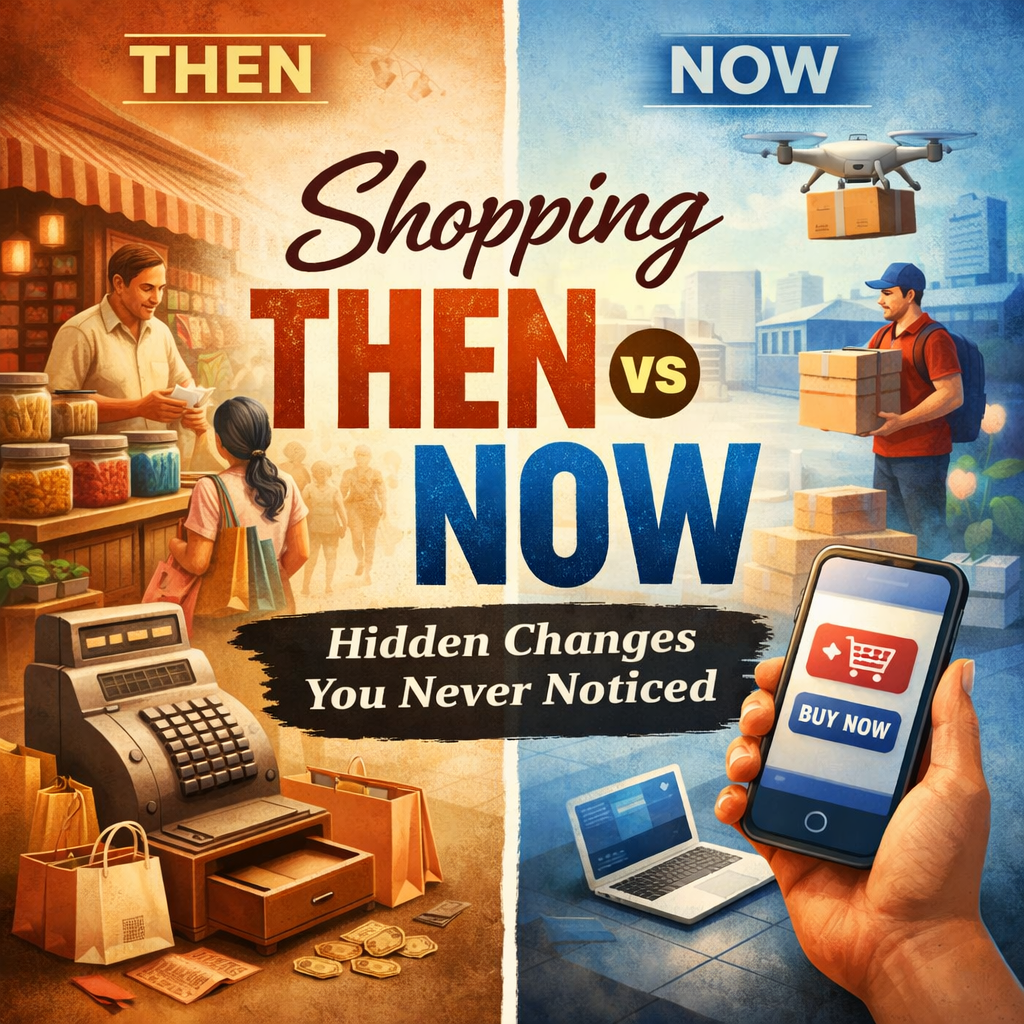
Shopping didn’t change overnight.
There was no announcement. No warning. No big moment.

Yet somehow, without realizing it, the way we shop today is completely different from how it used to be. Not just in how we buy things—but in how it makes us feel.
Let’s pause and uncover the silent, hidden changes between shopping then and now—the ones most of us never noticed.
1. Shopping Was an Event, Now It’s an Action
Then:
Shopping meant planning.
A fixed day. A fixed market. A shared experience.
You dressed up, stepped out, and gave time to the process.
Now:
Shopping is a tap.
Five minutes. Any place. Any time.
It fits between meetings, reels, and notifications.
👉 Hidden change: Shopping shifted from being an experience to a background activity.
2. Decisions Were Slower—but More Certain
Then:
Choices were limited.
You touched the product.
You asked questions.
You took time.
Once you buy something, you rarely doubt it.
Now:
Endless options.
Endless comparisons.
Endless reviews.
Even after buying, there’s doubt:
“Did I choose the best one?”
👉 Hidden change: More options didn’t bring more satisfaction—it brought more confusion.
3. Shopkeepers Knew You. Algorithms Study You.
Then:
“Bhaiya, yeh aapke liye sahi rahega.”
Shopkeepers remembered your taste, budget, and habits.
Now:
Apps track your searches, clicks, and pauses.
Recommendations appear before you even think.
👉 Hidden change: Human understanding was replaced by data prediction.
4. Spending Money Felt Real
Then:
You counted cash.
You felt the money leaving your hand.
Spending had weight.
Now:
UPI. Cards. Wallets. Buy Now, Pay Later.
Money moves silently—almost invisibly.
👉 Hidden change: When spending feels painless, spending increases without awareness.
5. Waiting Was Part of the Joy
Then:
If something wasn’t available, you waited.
If something was special, anticipation grew.
Now:
Same-day delivery.
Instant fulfillment.
Waiting feels like an inconvenience, not excitement.
👉 Hidden change: Patience disappeared, and so did the joy of anticipation.
6. Shopping Created Memories, Not Order History
Then:
Markets had sounds, smells, faces, and stories.
Shopping trips became memories.
Now:
Receipts live in emails.
Purchases live in the order history.
Nothing to remember. Nothing to retell.
👉 Hidden change: Shopping lost its emotional footprint.
7. Buying Was Need-Driven, Now It’s Trigger-Driven
Then:
You bought what you needed.
Now:
Flash sales.
Limited-time offers.
Personalized ads.
We buy because something appeared, not because it was required.
👉 Hidden change: Shopping moved from intention to impulse.
8. Returns Replaced Responsibility
Then:
You chose carefully because returns were difficult.
Now:
Easy returns encourage careless buying.
👉 Hidden change: Convenience reduced thoughtfulness.
9. Shopping Became Lonely
Then:
Shopping meant conversations—with family, shopkeepers, strangers.
Now:
You shop alone—with a screen.
👉 Hidden change: Shopping became efficient but emotionally isolated.
10. We Buy More, Enjoy Less
This might be the biggest change of all.
Closets are fuller.
Homes are crowded.
Satisfaction is shorter.
👉 Hidden change: Shopping became frequent, but fulfillment became rare.
Final Thought: The Quiet Transformation
Shopping didn’t just become digital.
It became faster, quieter, and less human.
We gained convenience—but lost connection.
We gained choice—but lost certainty.
We gained speed—but lost stories.
Maybe the question isn’t:
“Was shopping better then or now?”
Maybe it’s:
“What parts of old shopping do we still want to keep?”